Welcome to the Appalachian Mountains Joint Venture Website
The Appalachian Mountains Joint Venture (AMJV) is one of 18 habitat Joint Venture partnerships in the United States. The AMJV is comprised of state and federal government agencies, non-governmental organizations, and industries who work together to ensure the long-term sustainability of native bird populations that breed in the Appalachian Mountains. Also, the Appalachian Mountains region likely serves as a "source" population for several species of forest-breeding birds for adjacent habitat joint ventures (e.g., Atlantic Coast JV , Central Hardwoods JV , Upper Mississippi River/Great Lakes Region JV). Ensuring that populations of priority species in the AMJV remain viable will also help maintain, and we hope, improve populations in surrounding areas.
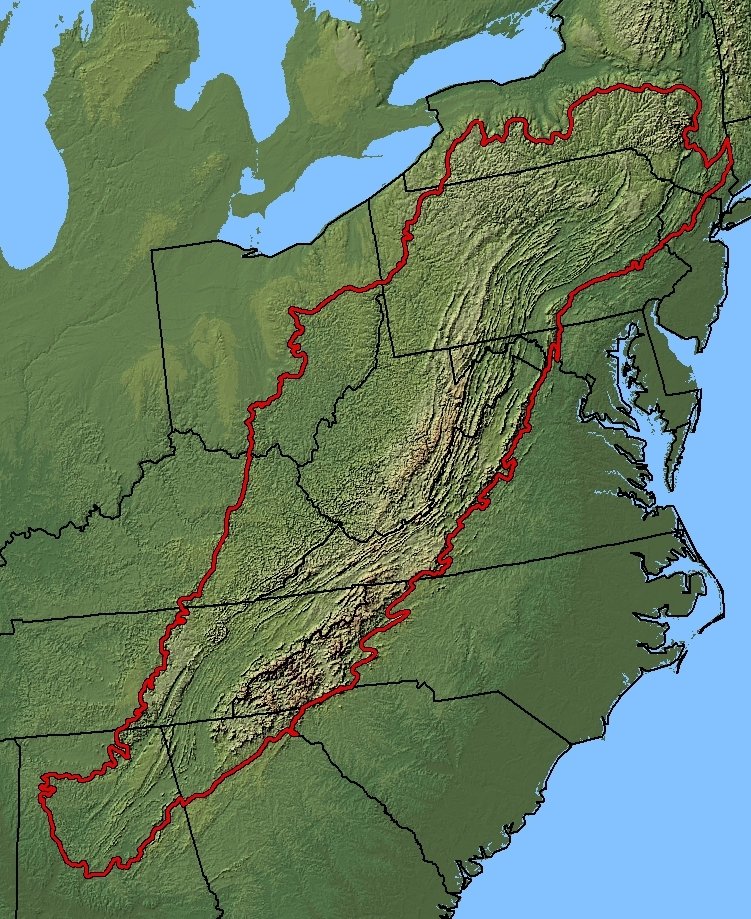
We concentrate our conservation efforts in the Appalachian
Mountains Bird Conservation Region (a.k.a, BCR
28), which includes all or portions of 8
Level III ecoregions. The
AMJV administrative area, slightly different from the
original BCR
28 boundary, encompasses 103 million acres and contains
some of the largest expanses of deciduous forest remaining
in the eastern United States, as well as innumerable unique
geologic features. The region is famous for its scenic vistas
that overlook forests that cover dissected ridges, tall 'spines'
with corresponding deep valleys, rolling hills, and the highest
peaks in the eastern United States. A high diversity of bird
species breed and winter in the AMJV, and the region is very
important for birds during migration.
Many of the bird species that inhabit this area migrate between Central and South America , Mexico , the AMJV, and Canada. Therefore, we will work with partners to design and implement efficient and effective conservation projects for native bird species throughout their annual life cycles, which includes breeding, migration, and over-wintering areas.
The AMJV office staff coordinates, assists, and works
with partners and others concerned with the conservation of
bird populations and habitats in the AMBCR.
|